🔬

Unsupervised Greek Biomedical Keyword Extraction

Fine-tuning BERT for domain-specific keyphrase extraction from Greek medical texts, with a novel diversity ranking mechanism

Python BERT NLP HuggingFace Biomedical NLP Unsupervised
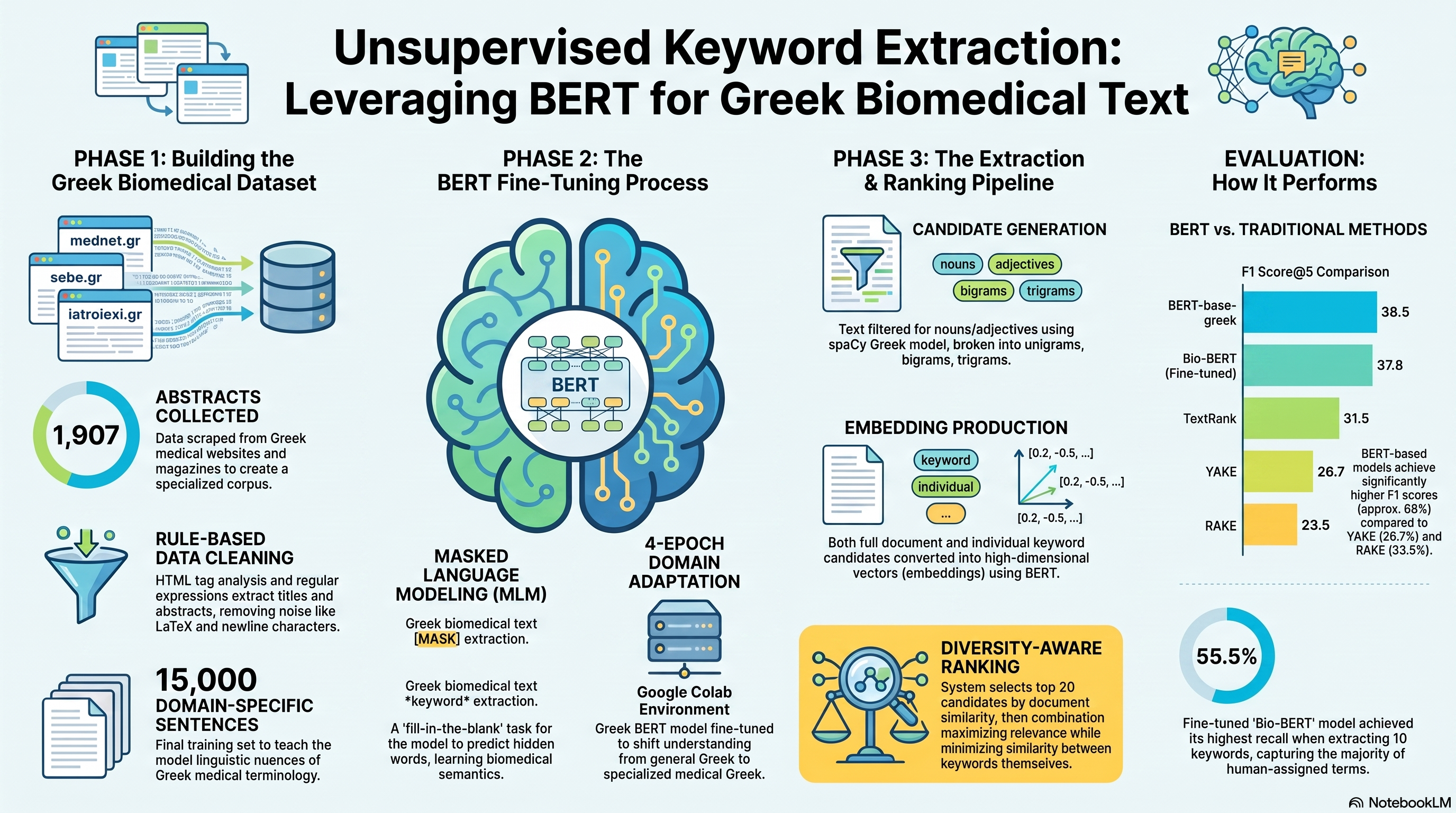
Greek Biomedical Keyword Extraction — Workflow Overview

Overview

The challenge of keyword extraction in a non-English biomedical domain

With the rapid growth of biomedical information, automated keyword extraction is crucial for summarizing content, topic recognition, and information retrieval. However, applying these techniques to non-English languages like Greek — especially in highly specialized domains like medicine — presents significant challenges due to the lack of dedicated, pre-processed datasets and domain-specific language models.

This project developed a robust, unsupervised machine learning pipeline that leverages contextual language representations from BERT to automatically extract highly relevant and diverse keywords from Greek biomedical texts. By fine-tuning on a custom-built biomedical corpus and implementing a novel diversity ranking mechanism, the system successfully addresses the challenge of summarizing and retrieving information within a specialized, non-English domain.

Dataset Engineering

Building a novel Greek biomedical corpus from scratch

1,907
Medical abstracts scraped from Greek biomedical platforms
15,000
Clean sentences extracted for language model fine-tuning
90/10
Train / test split (1,715 / 192 samples)
4 Epochs
Masked Language Modeling fine-tuning (15% masking)

To train and evaluate the model, a novel dataset was constructed from scratch by web scraping Greek biomedical platforms (mednet.gr, sebe.gr, iatrolexi.gr). Using rule-based extraction methods built around HTML tags, a total of 1,907 medical abstracts paired with their official titles and keywords were collected. The data underwent rigorous preprocessing — including lowercasing, and the removal of tabs, HTML, and LaTeX tags via regular expressions. An additional corpus of approximately 15,000 sentences was extracted using spaCy specifically for fine-tuning the language model.


Methodology

Three-stage unsupervised extraction pipeline powered by BERT

🔍

Candidate Generation

Producing high-quality keyword candidates through linguistic filtering and n-gram extraction.

Merged document titles & abstracts
Greek NLTK stopword removal
spaCy POS tagging (nouns & adjectives only)
Generated unigrams, bigrams & trigrams
🧮

Domain-Specific Fine-Tuning

Adapting Greek-BERT to biomedical semantics through Masked Language Modeling.

Foundation: Greek-BERT (Koutsikakis et al., 2020)
Fine-tuned with MLM on 15K biomedical sentences
4 epochs, 15% token masking
Document (max 512) & candidate (max 32) embeddings
📊

Embedding Generation

Dense vector representations via average pooling over BERT's last hidden state.

HuggingFace Transformers inference
Average pooling over last hidden layer
Document embeddings: max 512 tokens
Candidate embeddings: max 32 tokens
🎨

Diversity Ranking

Maximizing relevance while ensuring the final keyword set is diverse and non-repetitive.

Cosine Similarity to find top 20 relevant keywords
Keyword-to-keyword similarity minimization
Selects combination with minimum mutual similarity

Evaluation Framework

Partial matching metrics and qualitative diversity assessment

The system was evaluated against a test set of 192 samples using partial matching — due to the inherent difficulty of perfectly matching syntax in unsupervised extraction — and assessed through Precision, Recall, and F1 metrics at k=5 and k=10. The BERT-based approaches were benchmarked against traditional unsupervised baselines: YAKE, RAKE, and TextRank.

Beyond raw metrics, qualitative evaluation played a critical role. While graph-based methods like TextRank scored well on raw recall, they suffered from generating highly repetitive and redundant keywords. The BERT-based pipeline consistently produced semantically rich and distinctly diverse keyphrases.


Results

BERT-based approaches heavily outperform traditional baselines

38.5%

F1@5 Score — Base Greek BERT (best overall)

35.4%
Precision@5
42.2%
Recall@5
<1 sec
Inference time per document

Performance Comparison (k=5)

F1, Precision, and Recall across all models

Model Precision@5 Recall@5 F1@5 Inference Time
Greek BERT (base) 35.4% 42.2% 38.5% ~1 sec
Bio-BERT (fine-tuned) 34.1% 42.4% 37.8% ~1 sec
TextRank 28.3% 35.6% 31.5% ~0.5 sec
YAKE! 24.1% 29.9% 26.7% ~0.3 sec
RAKE 21.2% 26.4% 23.5% ~0.2 sec

Performance at k=10

Extended extraction reveals strong recall from fine-tuned model

55.5%

Recall@10 — Fine-tuned Bio-BERT

32.8%
F1@10 (Bio-BERT)
31.5%
F1@10 (Greek BERT)
<1 sec
Inference time

At k=10, the fine-tuned Bio-BERT achieved the highest Recall of 55.5% and a competitive F1 score of 32.8%. Beyond raw metrics, qualitative evaluations showed that the BERT-powered extraction produced highly accurate, diverse keyphrases — solving the issue of repetitive keyword outputs commonly seen in graph-based algorithms like TextRank. This proved that contextual embeddings can successfully learn and summarize specialized Greek biomedical vocabularies.


Tech Stack

Languages, frameworks, and environment

Languages

Python

Models & Frameworks

BERTGreek-BERTHuggingFace TransformersspaCyNLTK

Baseline Algorithms

YAKE!RAKETextRank

Environment

Google Colab (Tesla T4 GPU)

Key Academic References

Papers used in model design and methodology

[1] Devlin, J., Chang, M. W., Lee, K., & Toutanova, K. (2018). BERT: Pre-training of deep bidirectional transformers for language understanding.
[2] Koutsikakis, J., Chalkidis, I., Malakasiotis, P., & Androutsopoulos, I. (2020). Greek-BERT: The Greeks visiting Sesame Street.
[3] Campos, R., Mangaravite, V., Pasquali, A., Jorge, A. M., Nunes, C., & Jatowt, A. (2018). YAKE! Collection-independent automatic keyword extractor.
[4] Mihalcea, R., & Tarau, P. (2004). TextRank: Bringing order into text.
[5] Rose, S., Engel, D., Cramer, N., & Cowley, W. (2010). Automatic keyword extraction from individual documents. (RAKE)